Records Records - Part 14: American Sporting Cities
The least to most succesful cities and states in the (really) big leagues

At the time of writing this, it’s been just over a week since the Philadelphia Eagles stunned the Kansas City Chiefs in Superbowl 59. It was the 2nd time in the past 3 years that those teams met in the grand final of the most lucrative domestic sporting league in the world, and the 5th time the Chiefs have been in the Superbowl in the past 6 years. But how does this compare to the broader history of the NFL? Have the fans in Kansas City always had so much to cheer for? Or is this a recent surge in success? Do they do well in other leagues too? What about Philadelphia? Or for that matter other world renowned cities like New York or Los Angeles? Well, today we’re going to explore the varying fortunes of the panoply of cities that host a team in at least one of the biggest sports leagues in North America.
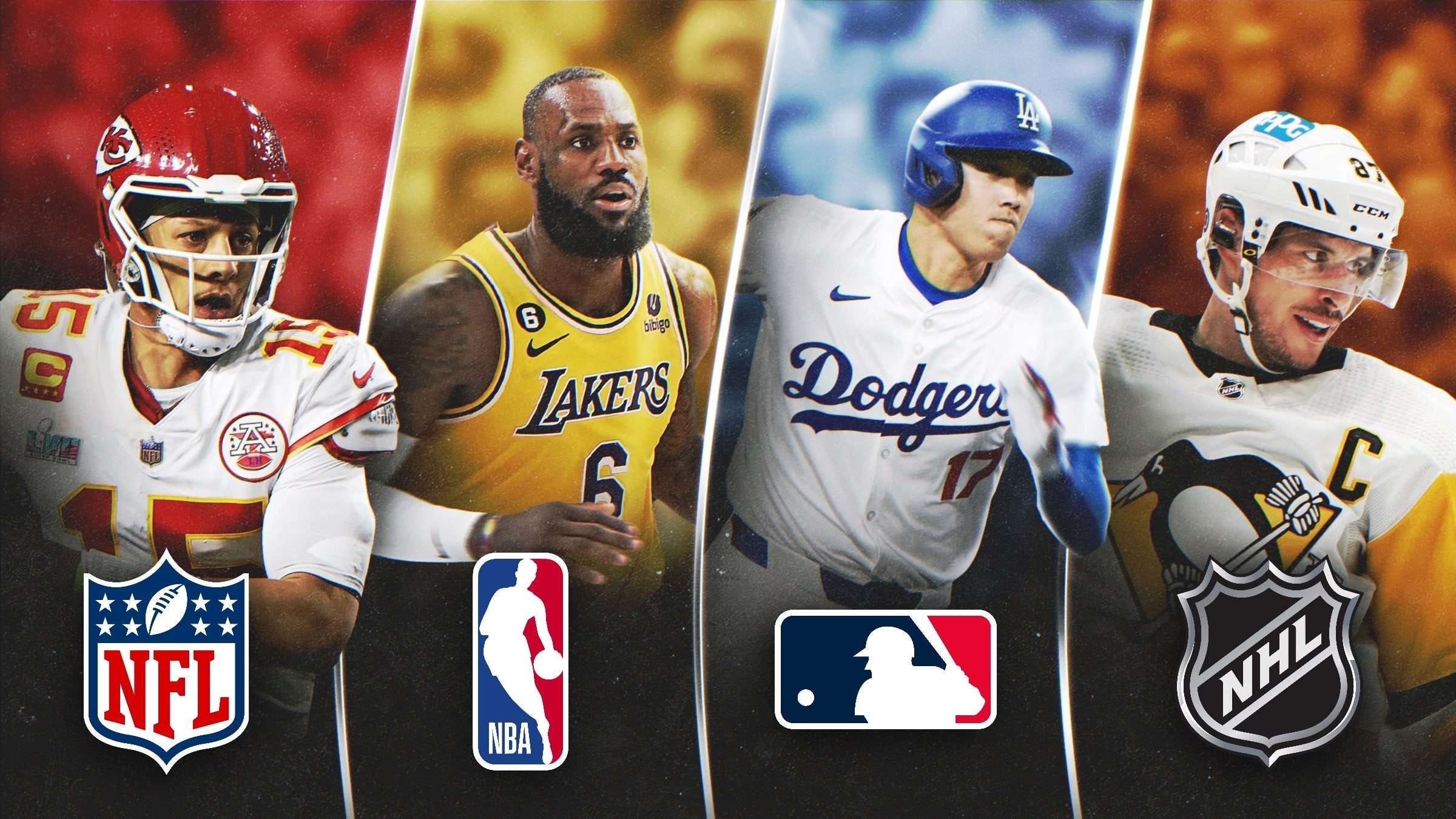
Household names across the biggest 4 leagus in North America. Image from here

I have long been amazed at the scale of major league sports in the United States. Sure, they have a large and wealthy market to utilise, but it still feels incredible that they can support:
32 football teams (the American variety) in the NFL
30 basketball teams in the NBA
30 baseball teams in the MLB
32 ice hockey teams in the NHL
And, the rising financially competitive league of 30 more football teams (the original variety this time) in the MLS.
They also support professional rugby union and rugby league competitions, a T20 cricket competition, a lacrosse league, polo, and frankly any other professional sport you can name. But, the big 4 (and more recently the big 5), are the NFL, NBA, MLB, NHL, and MLS. If you’ve already got acronym fatigue, well, it’s going to continue throughout this piece, it’s just a lot easier to say NBA than National Basketball Association. Though I might occasionally just say “baseball” instead of MLB, and you’ll know that I’m not referring to baseball in its entirety, just the 30 teams that form the highest tier of professional baseball in the USA.
The scale of this professional sporting landscape is mind blowing. I mean, the biggest 3 leagues in North America are also the top 3 in the world in terms of revenue, and the number 5 spot globally is American too. That’s crazy! To sustain this scale, many of the megacities of America have a team from each league, or at least most of them. And in some cases double ups within a given league! Think the New York Giants and New York Jets of the NFL, or the LA Dodgers and LA Angels of the MLB. This got me thinking about which cities have had the best and worst fortunes in terms of sporting representation and success across the big leagues. Which citizens have had the most or least to cheer about in living memory? Or, which states have outdone themselves in terms of success despite market size and population? So, today we’re going to do a deep dive on the distribution of professional teams across the North American continent, and how each city has fared in regards to their share of best players and championships, or lack thereof.
To start, let’s get an idea of how these leagues compare. How many teams, how are they spread around the continent, how old are they, and who makes the most of the fat purse of American sporting consumption. Well, between these big 5 leagues, we have a total of 154 teams spread across 2 countries. It’s 2 countries because every league except the NFL has at least 1 team based in Canada. Here’s how they compare:
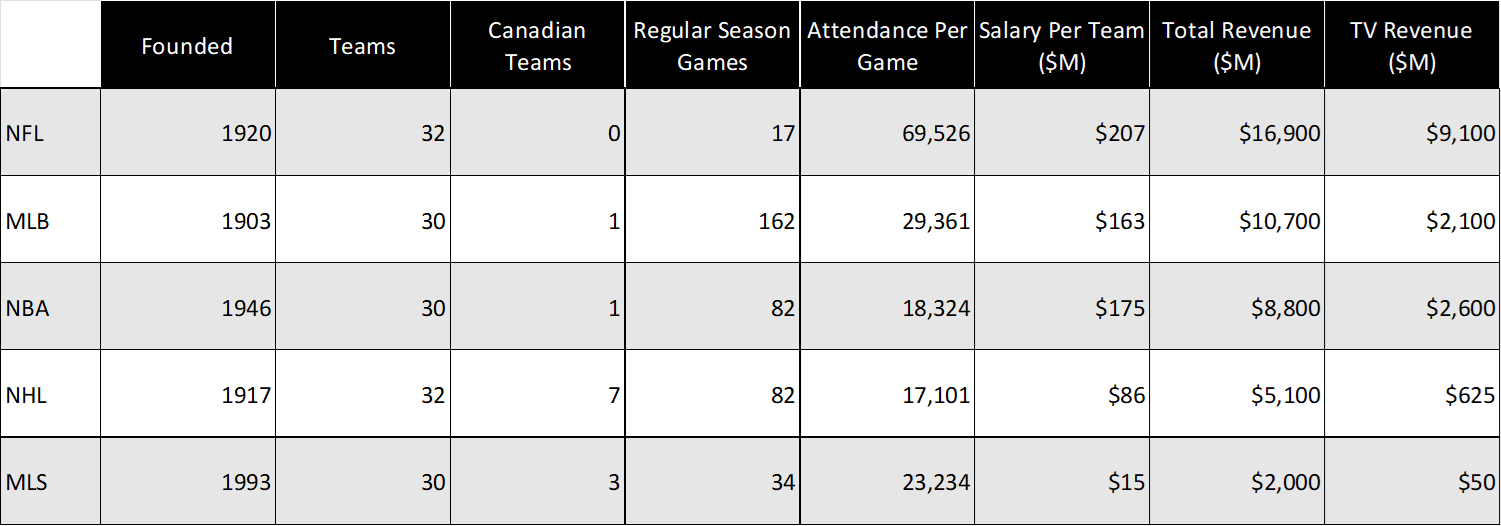
We can see that the numbers fluctuate heavily across the board, except for league size, with each competition having 30 or 32 teams. The number of teams that are situated across the border changes drastically, with as little as none (the NFL), and as many as almost a quarter of the league (the NHL). The number of games per season has the widest spread, from 17 in the NFL, it doubles to the next with 34 in the MLS, then more than doubles again with 82 in the NBA and NHL, before the truly crazy number that they play in the MLB, 162 regular season games. 162! As such, total attendance (which I didn’t show here), is unparalleled outside the MLB. Their per game is already second best, but they play so, so, so many games that the total is over 70 million for a season. 70 million people attend MLB games every year!
But the per game bar is definitely set by the NFL. I guess if you’re used to the other big leagues in North America, 17 games feels incredibly few, making each game more important and more worth attending, but that’s a very impressive per game average across the league. For comparison, the average attendance at the EPL (English Premier League, top flight soccer in the UK) is 40,000, the average at the IPL (Indian Premier League, highest level domestic cricket in India), is 42,000, and for the AFL (Australian Football League) it’s around 38,000. Only motorsports get more attendees per fixture than the NFL.
The NFL is also atop the pile (both in the big leagues we’re talking about here and across the world) for money. In fact, the top 3 leagues in North America are also the top 3 leagues globally in terms of revenue, and the NHL is number 5. The MLS is even number 10, so the big 5 leagues of the USA take up half the top 10 globally. There is a lot of money in sport in America.
The NFL is the biggest of the big though, with 60% more revenue than the next (MLB). And the MLB and NBA rely on their staggering number of games and attendance to boost their revenue, as we can see by the TV revenue. The NFL has more than quadruple that of the MLB and NBA!
Considering the vast amounts of money up for grabs, teams tend to be located where they are because of the size of the local market. This is particularly true for non NFL teams, which rely more heavily on attendance for a large part of their revenue. But many metro areas in North America are absolutely massive, and can support teams from all of the leagues, and sometimes even double ups as well.
11 cities have at least one team from each of the big 4 leagues, and all but one of them (Detroit), also have a MLS club. Here they are:
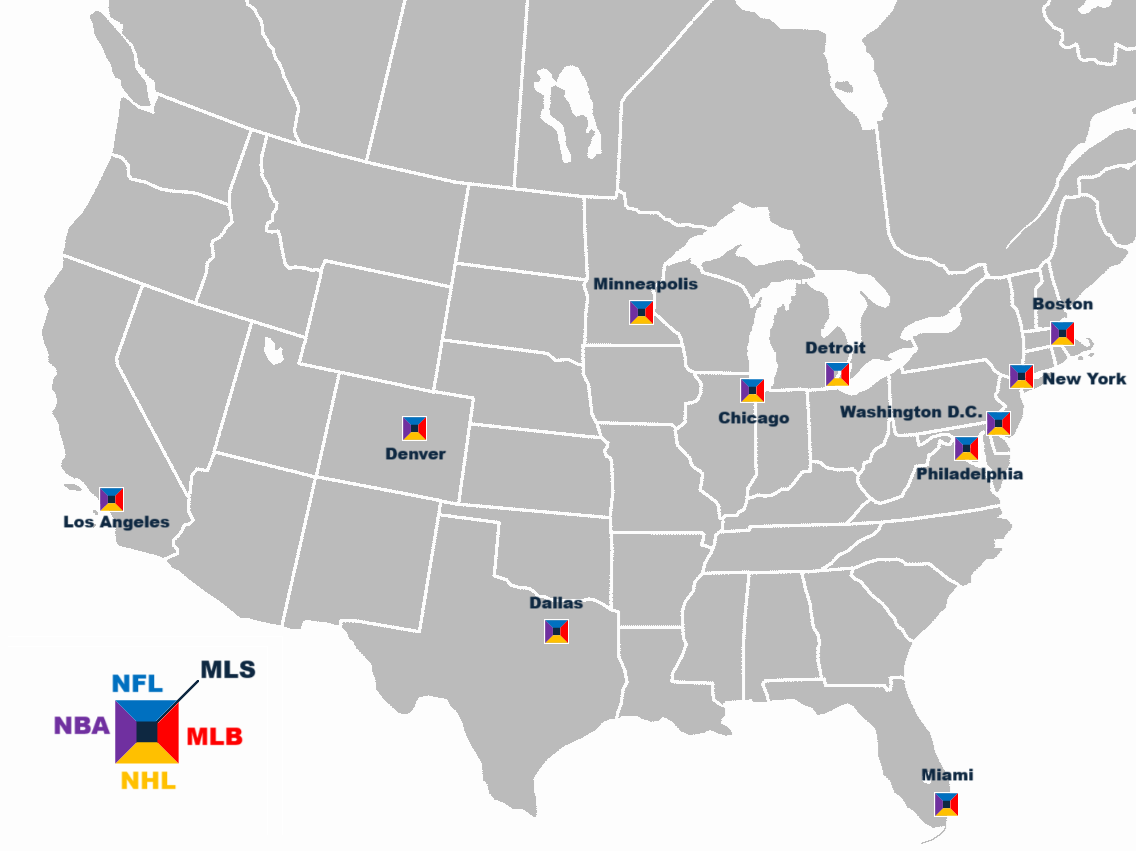
LA and NY go so far as to have 2 teams from all 5 leagues! Chicago also has a 2nd baseball team. The locations shown on that map combine for 65 of the 154 teams, so close to half of the major professional sports teams are found in these 11 cities. The northeast corner has the highest density, with Canada and the northwest of America under-represented. Though, there are many cities in Canada with a club, and Seattle has all of the leagues present except for the NBA (which it once had, and could soon have again).
Here’s the full picture of where every single major league team is based:
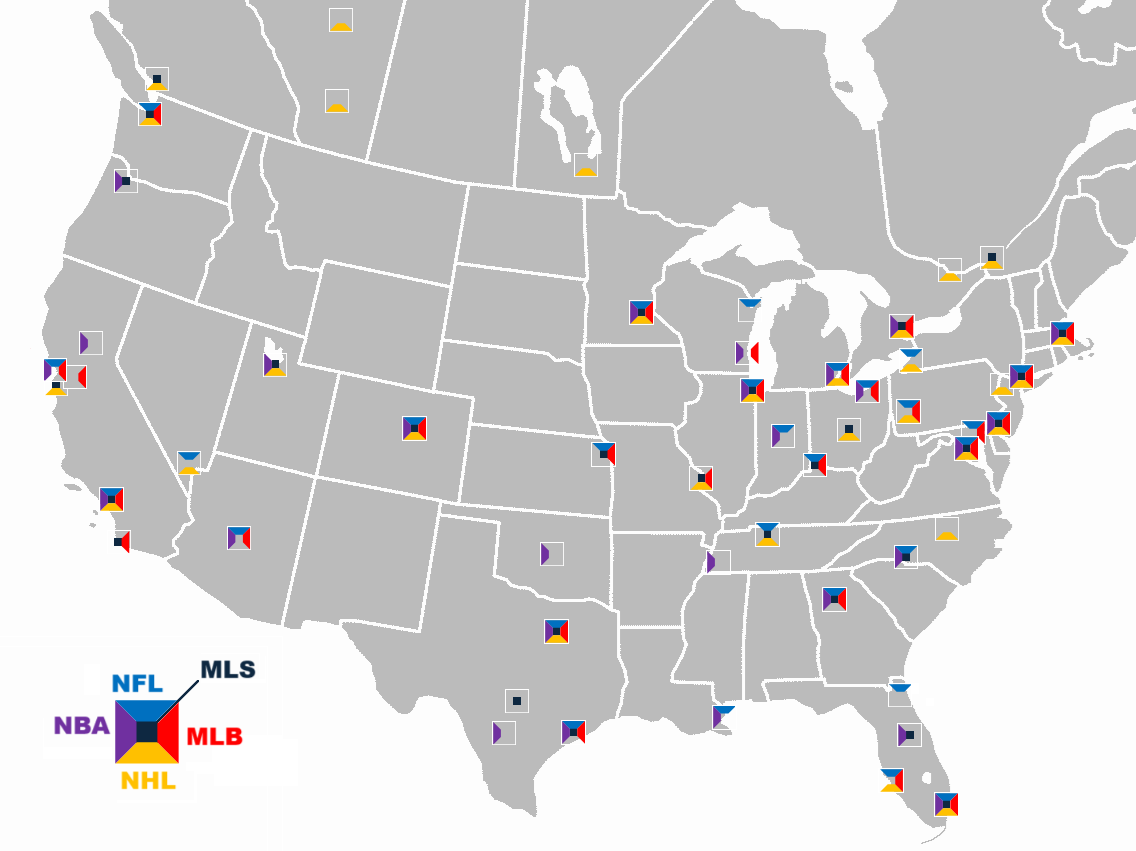
I didn’t label this one as I thought it would be too confusing. But that does make it hard to reference later. So maybe I’ll label a couple of interesting points to talk about:
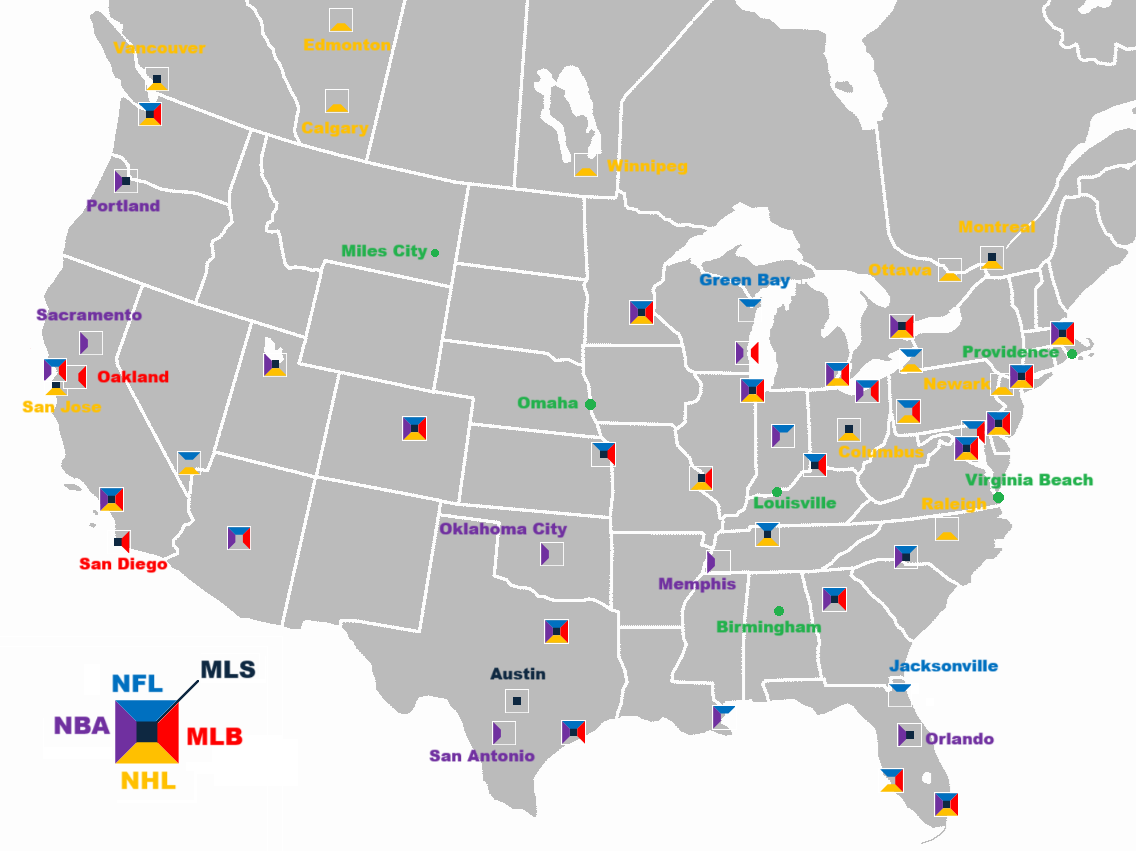
Colour coded for talking points.
The blue, purple, red, or yellow named cities are places that only have 1 of the big 4 teams, though many also have an MLS team. The only city that has MLS and nothing else is Austin Texas.
There are lots of cities that just have 2 of the big 4, or the big 5 for that matter, but what about places with no teams? Well, let’s talk about those green labels.
There are many states with multiple cities that have professional teams, and there are many that have none whatsoever. Lots of these are the sparsely populated northwestern states, like Wyoming, Idaho, the Dakotas, etc. Currently, the state with the smallest population that has a big 4 team is Nevada, thanks to the Las Vegas Raiders and Golden Knights of the NFL and NHL respectively. There is also talk of an NBA expansion team for Vegas as well. This despite Nevada only having a population of around 3 million. There are a bunch of states without any team that have populations above 3 million. If they were to get a team, I have flagged where they logically would be:
Birmingham: a metro population of 1.7 million, within the proud sporting state of Alabama (population of 5 million), it’s weird there’s no pro team here already. Birmingham is bigger than many existing markets with multiple teams, and Alabama is more populous than 6 currently represented states, including their neighbours in Georgia
Louisville: Kentucky has a population of 4.5 million, and Louisville has a population of over 1.3 million. It also straddles the border with Indiana, a populated state that currently only has teams in Indianapolis
Virginia Beach: this is the big one, Virginia has a population of over 8 million, and yet no pro sports teams in the state! Virginia Beach is also a large city, with a metro population of 1.8 million and gets lots of tourists due to it’s seaside location
Omaha: the word Omaha is already associated with sports thanks to the great Payton Manning, but it also deserves a sports team of its own. Neither Iowa nor Nebraska (the states that Omaha straddles) have a pro team, and their combined population exceeds 5 million, plus Omaha has a metro pop approaching a million, more than many existing cities with pro teams
Then, there are 2 more green labels on there. Providence is a large city, over 1.6 million, and Rhode Island has no teams. But, it is very close to lots of large cities with lots of teams, so doesn’t really fill a clear void. Speaking of voids though, the last green label on there is Miles City. This is a mighty Montana city of 8 thousand people. Why is it on there? Well, according to my work, the geographic spot that is the furthest from any current major sports team falls just a few kilometres down the road from Miles City. I spent ages calculating distances between latitudes and longitudes, and I’m pretty sure that is the spot furthest from any team while still being within the continental United States, with the nearest team over 740 km away. So I vote to put a pro team in Miles City! Who cares about population size, it fills a clear hole in the market.
Alright, enough on the geography of the major teams. But before we get into the successes of these places, let me tell you about my whimsical (though data driven) side-quest into team logos and names.
I compiled a list of all the teams from the big 5 leagues, specifying their name, what their logo depicts, and how these should be categories. I.e., the New York Giants, they are named after people of great stature, but their logo is a simple stylisation of NY. So they fall into the peoples/person category for team name, but the alphanumeric category for logo. I did this for all 154 teams. A few trends came out straight away. Overall, soccer and baseball vastly prefer to use letters and numbers in their logos, with much less characters or animals etc. The NFL and the NBA on the other hand, have many more of these lively figures in their logos. The MLS on the other hand doesn’t just abhor characters in their logos, they even shy away from such frivolous team names, with the majority of clubs simply referring to their locale, like St Louis FC, Minnesota United, FC Dallas, and so on.
Then, the tendency for one league to prefer certain categories of team names and logos was also pretty strong. The NFL has the strongest connection to animals, with almost half of their teams named after one, like the Rams, Bears, Lions, Ravens, Falcons, etc. But, they don’t really go in for aquatic animals, with the Dolphins being the only team named after an animal that lives in the water. The NBA and MLS share this aversion, with no water animals featured, while the MLB have 2 (the Marlins and the Rays). But the NHL is down for water critters, with 4 of their 32 teams named after them: Seattle Kraken, Pittsburgh Penguins, San Jose Sharks, and Vancouver Canucks (first nations word for Orcas). Though I admit it’s a bit of a stretch to classify Penguins as water creatures. But they’re certainly winged, and this is a less polarising category. The NHL has 2 winged teams, (Penguins, Ducks) the NBA and MLB have 3 each, (Pelicans, Hawks, Hornets, Orioles, Bluejays, Cardinals) and the NFL has the most with 5 (Falcons, Cardinals, Eagles, Ravens, Seahawks).
You may have noticed a double up there, with both the MLB and the NFL having a team called the Cardinals (St Louis and Arizona). It’s not the only one either, you’ll find:
the Jets in both the NFL and NHL (New York and Winnipeg)
the Giants in both the NFL and MLB (New York and San Francisco)
the Rangers in both the NHL and MLB (New York and Dallas)
the Panthers in the NFL and NHL (Carolina and Florida)
the Kings in the NBA and NHL (Sacramento and Los Angeles)
There are also the teams of yesteryear that have since moved on or been renamed, as we’ve had across the leagues 2 Oilers (Edmonton currently and Houston/Indianapolis previously), 2 Capitals, and 3 Tigers (the Cincinnati Bengals and Detroit Tigers currently, and the Richmond Tigers previously). I understand that with 154 pro teams knocking about in these 5 leagues we were bound to get some double ups, but come on gang, there’s a lot of untapped potential. What about the dragons? Anyway, on top of the straight up copies, we also have some honorary mentions for name similarities:
the Timbers and Timberwolves (MLS & NHL)
the Rockies and Rockets (MLB & NBA)
the 49ers and 76ers (NFL & NBA)
the Blues, Blue Jackets, and Blue Jays (NHLx2 & MLB)
the Reds, Red Wings, Red Sox, and Red Bulls (MLBx2, NHL, & MLS)
the Bulls and Red Bulls (NBA & MLS)
the Bears and Bruins [Bruin means Bear] (NFL & NHL)
and the Packers and Pacers (NFL & NBA)
But we’ve been side tracked. We were already on a side point, talking about breakdown of team names by category, and then I got even further off in the weeds on duplicate (or almost duplicate) names. Back to it!
In the end I classified a team name’s origin as either based on a person (a job, actual individual, group of people, etc.), an animal, a colour, a location, a vehicle, on nature (like mountains, rivers, etc.), or on something else. This is the breakdown by league:
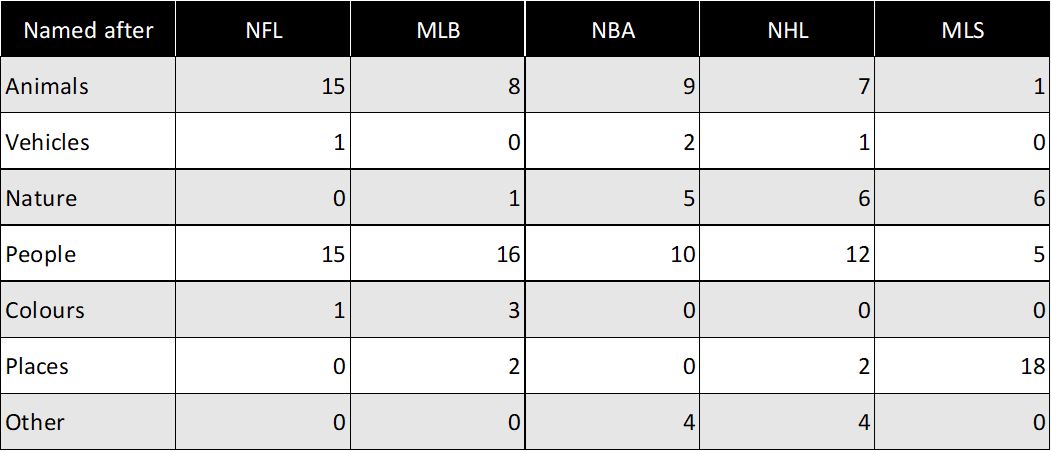
Now let’s look at each league individually:
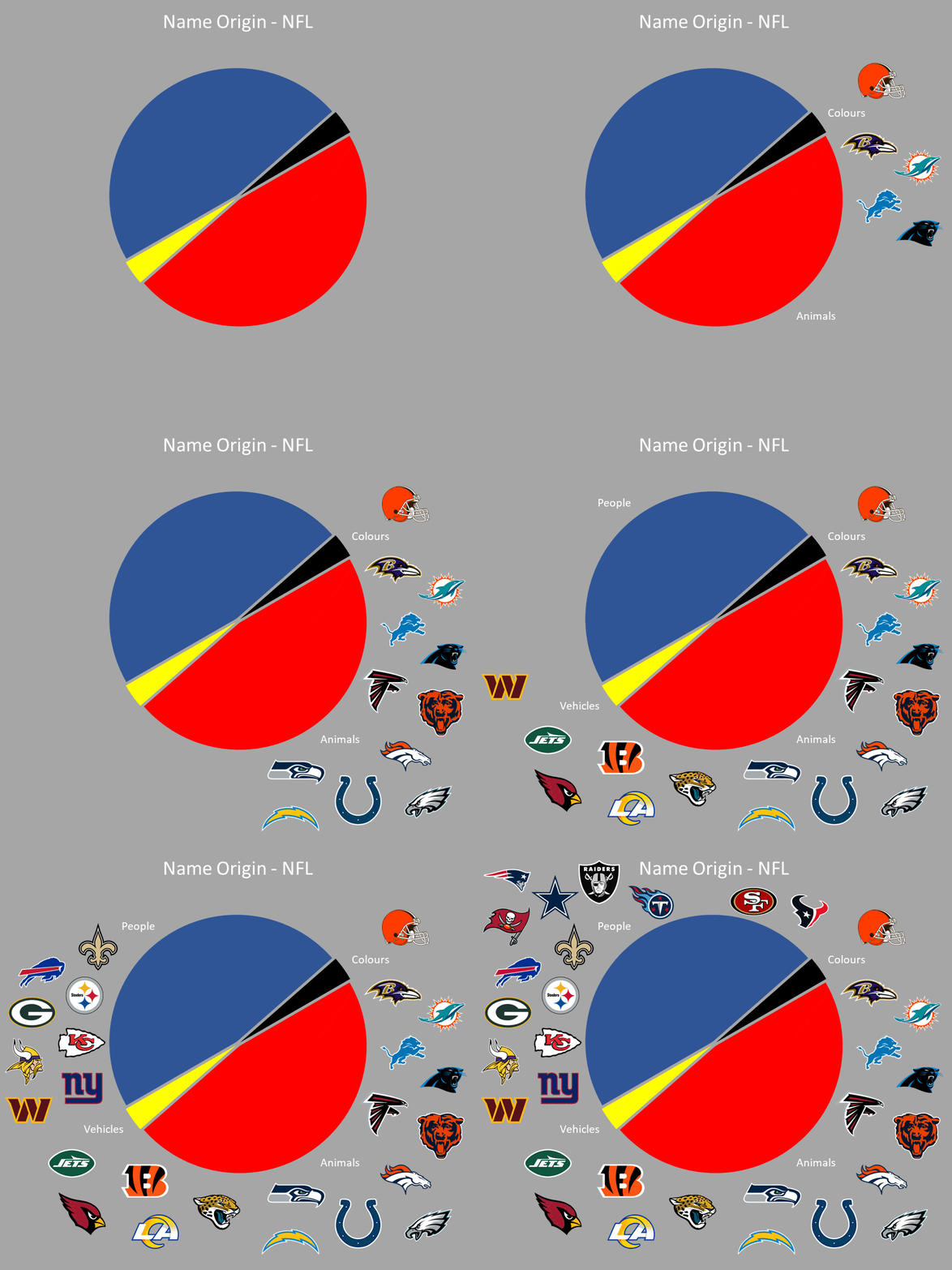
Only 2 teams in the NFL are based on something other than an animal or a person, and it has by far the most animals of any of the big 5 leagues. Also the Browns were technically named after a person, but they’ve leant into the colour theme of their name so I left them as a colour classification.
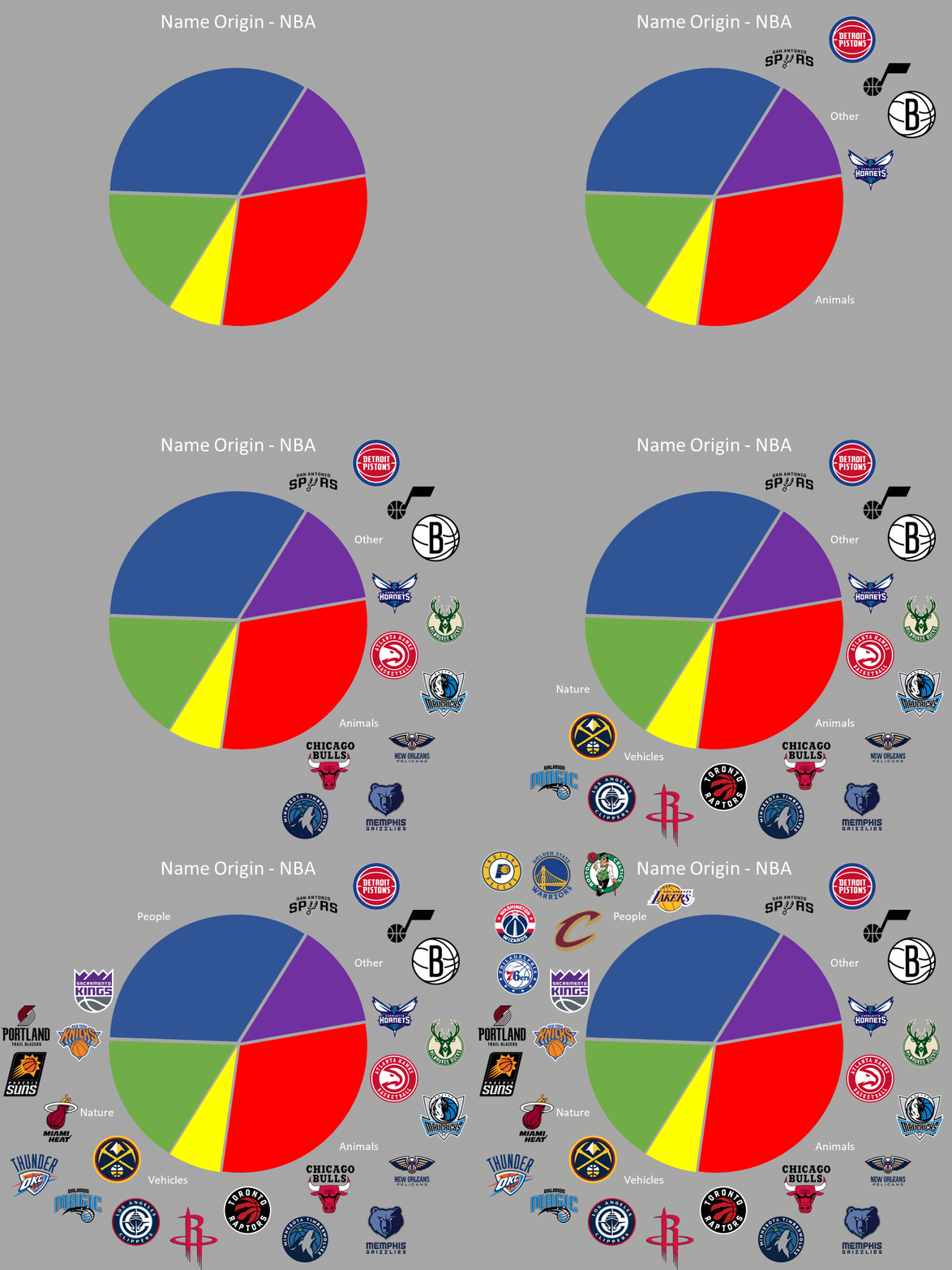
Thanks to the Jaz, the Spurs, the Pistons, and the Nets, the NBA has the most “other” teams, whose names aren’t easily classifiable. I almost put pistons in the vehicle category, but that wasn’t quite right. Lot of nature based teams as well, though some of these would probably make more sense in the other category, like the Nuggets, the Magic, and the Heat. Oh well.
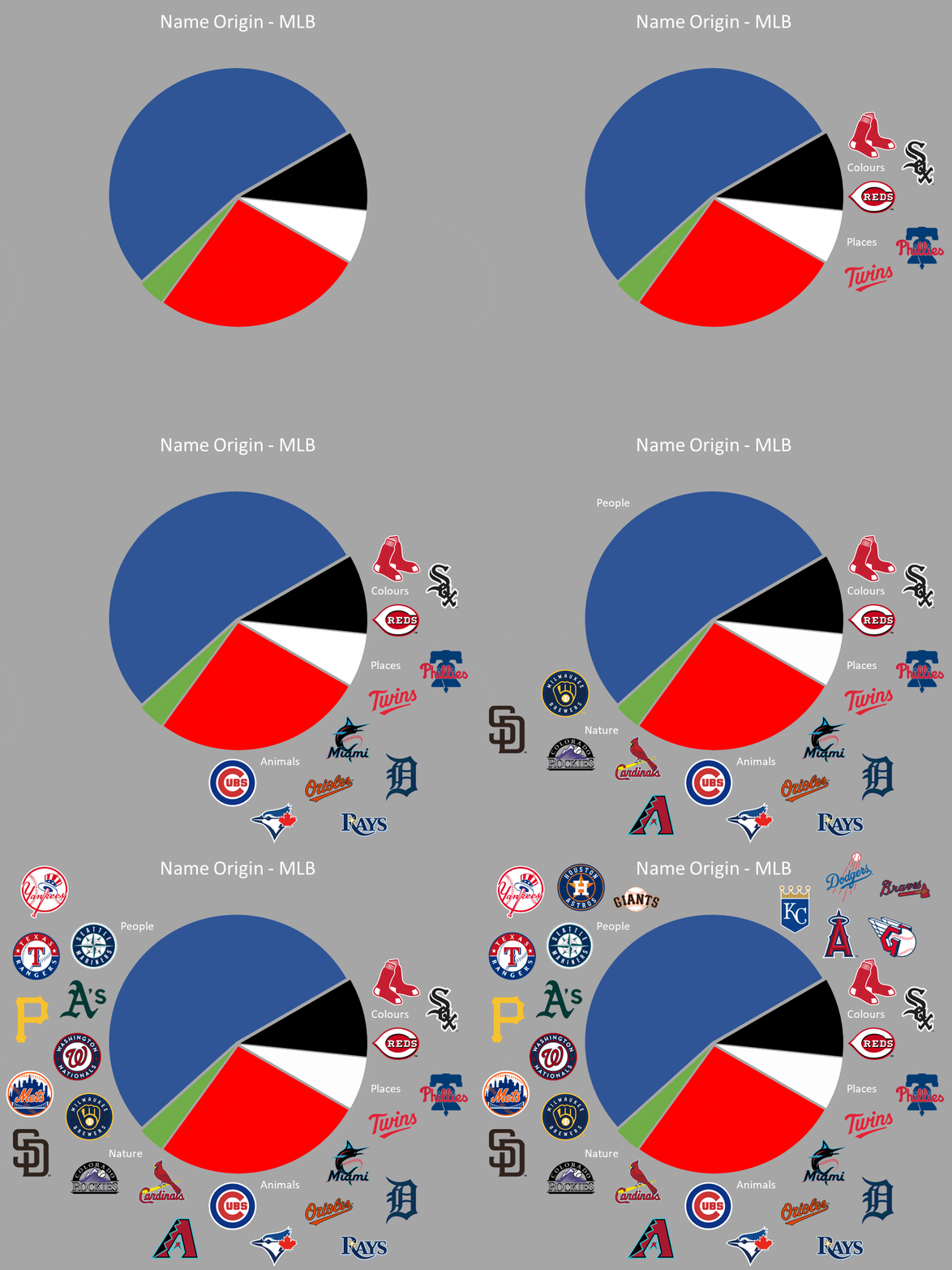
Baseball has by far the most names that originate from people, like Rangers, Brewers, Mariners, Yankees, etc. I made the call for both the NFL and MLB that “Giants” and “Titans” refer to people of great metaphorical stature, not actual mythological beings. That’s me being boring though and I could easily be convinced otherwise.
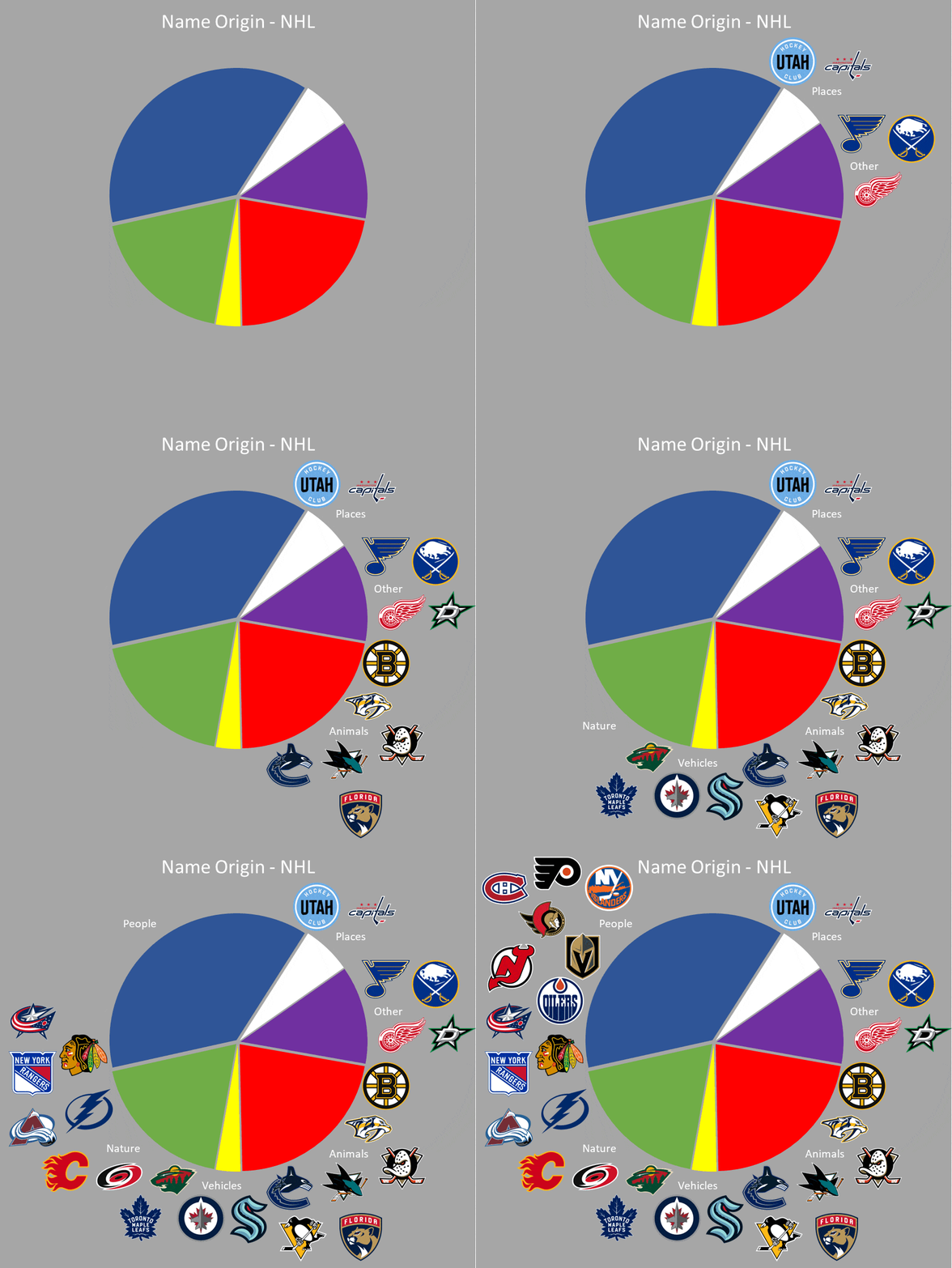
Hockey is the most diverse with it’s name origins. We already discussed that they are more comfortable with aquatic animals than the other leagues, but they are also the only league to have nature, vehicles, and straight up place names, as well as the ubiquitous people and animals. They’ve also got some item or abstract based ones, like red wings, stars, sabres, and the blues, which I didn’t categorise as a colour because it’s based on the genre of music of the same name.
But we’ve dallied in these fluffy concepts too long. It’s time we actually got into why I started this whole piece: which city or state has had the most or least success across the big 4 (and more recently the big 5) leagues?
Well, to provide some scope to the project, I decided to classify success in 3 ways:
Winning the championship
Making the championship
Having the best player in the league
The first one is obvious, how many titles does a team have. I went with the second one as well, because getting to the final is the hardest part, few teams ever even manage that. Winning the championship is then the icing and can come down to unlucky injuries or referee calls. Getting there requires a season of consistent greatness, so 2nd place is counted in this exercise as well.
Then, for the third point. I figured that even if your team isn’t playing in the finals, if you’ve got the best player in the league in a given year that’s something to be proud of at least. So I’m also counting teams whose player won MVP.
With that in mind, here are the all time results for championships, 2nd place results, and MVPs across the NFL (in the Superbowl era since 1966), the NBA (since the 1949 merger), the MLB (since 1903), the NHL (since 1926), and the entire history of the MLS:
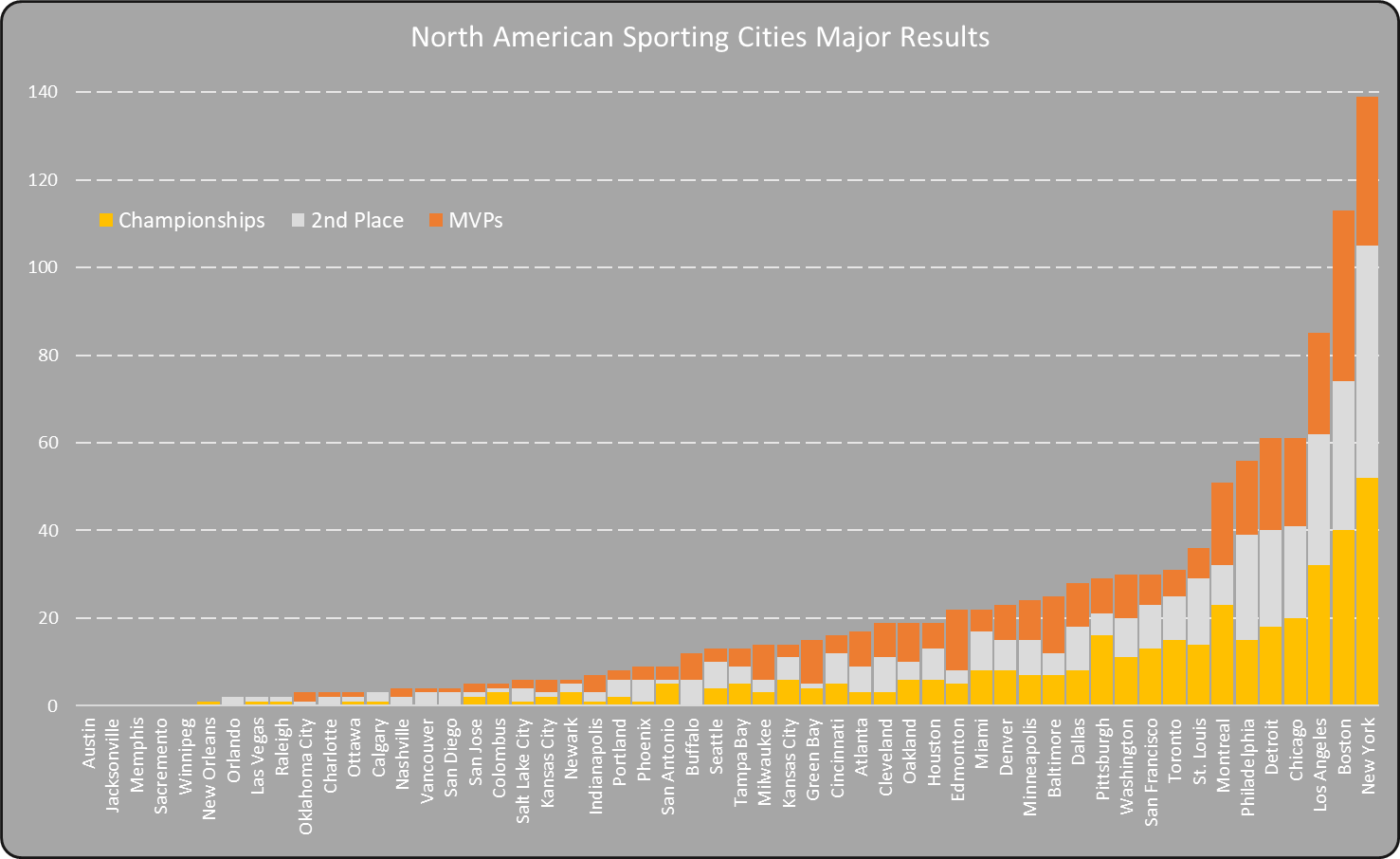
Understandably, New York and LA, with 2 of each of the big league teams, account for a massive portion of the success column. Boston also looms large. But, and I think this is a pretty big but, all of the big 5 leagues started off with very few teams. For much of their history all the championships and awards were being given to a comparatively small pool, and so that graph up there disproportionately makes the older teams look more successful than the newer ones. I mean, they are more successful, clearly, but they’ve not only had more time to be successful, they had the opportunity to do it when there were less teams vying for the prize.
So, let’s limit the range to the last 60 years. This doesn’t fully solve the problem, as most leagues didn’t start properly expanding until the 70s and 80s, but it does cut out a lot of history that had only a handful of teams present and in which lack of salary cap meant the big cities always did better. 60 years is also a handy range of “within living memory”, where fans still recall key achievements and events. Here are the results trimmed to the past 60 seasons:
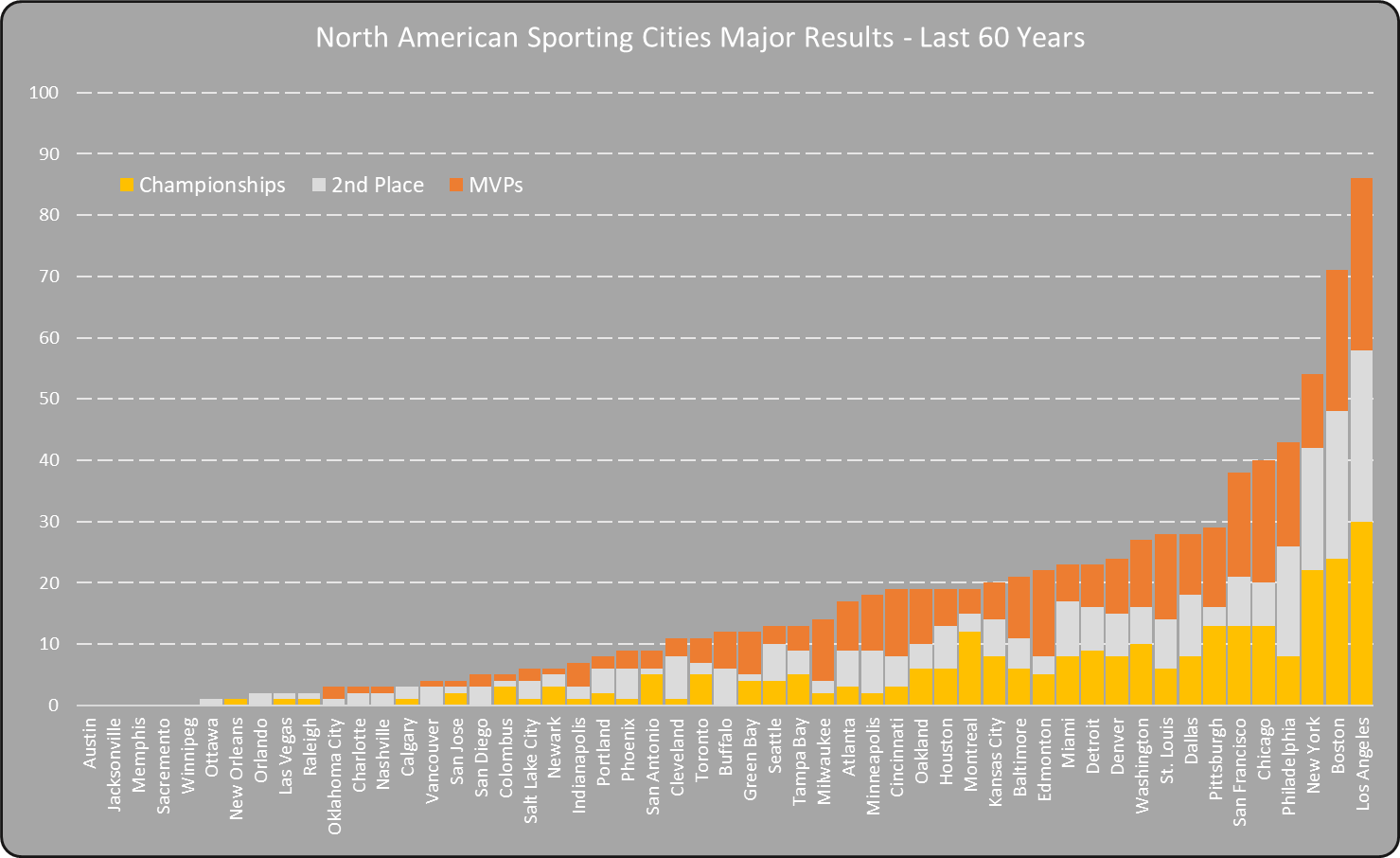
At first glimpse this looks very similar, but we can see that New York has dropped back significantly, and just in general it isn’t quite as forward stacked as the all-time graph.
Alright, let’s break it down by sport.
NFL first, and in this case the 60 year limit doesn’t do anything as the Superbowl era started 59 years ago:
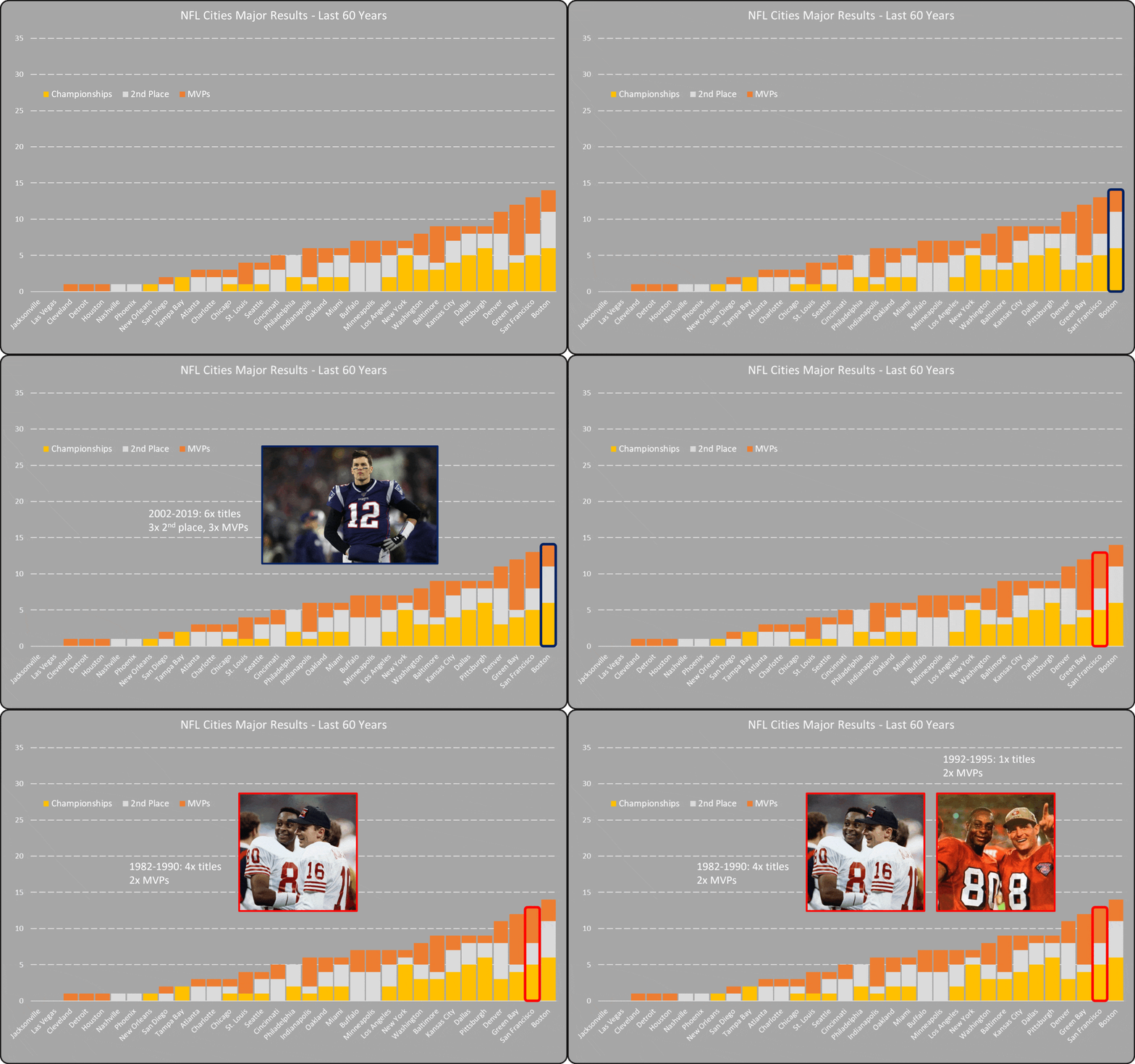
Boston has the slight lead, as while it’s tied for championships with Pittsburgh, the Patriots have made a lot more finals courtesy of that ridiculous dynasty of Brady and Belicheck. But San Francisco and Green Bay have more MVPs, courtesy of household names like Joe Montana, Brett Favre, Steve Young, and Aaron Rogers. Green Bay is in general a massive outlier, being in the top 3 of this graph despite a population less than 400,000. As far as the NFL goes, only Jacksonville and Las Vegas have never tasted a Superbowl appearance or MVP, as the Raiders had all their success in Los Angeles and Oakland, while the Jaguars haven’t had much luck in their first 30 years.
Now, NBA, where the 60 year mark robs us of half of that incredible Boston dynasty of Bill Russell:
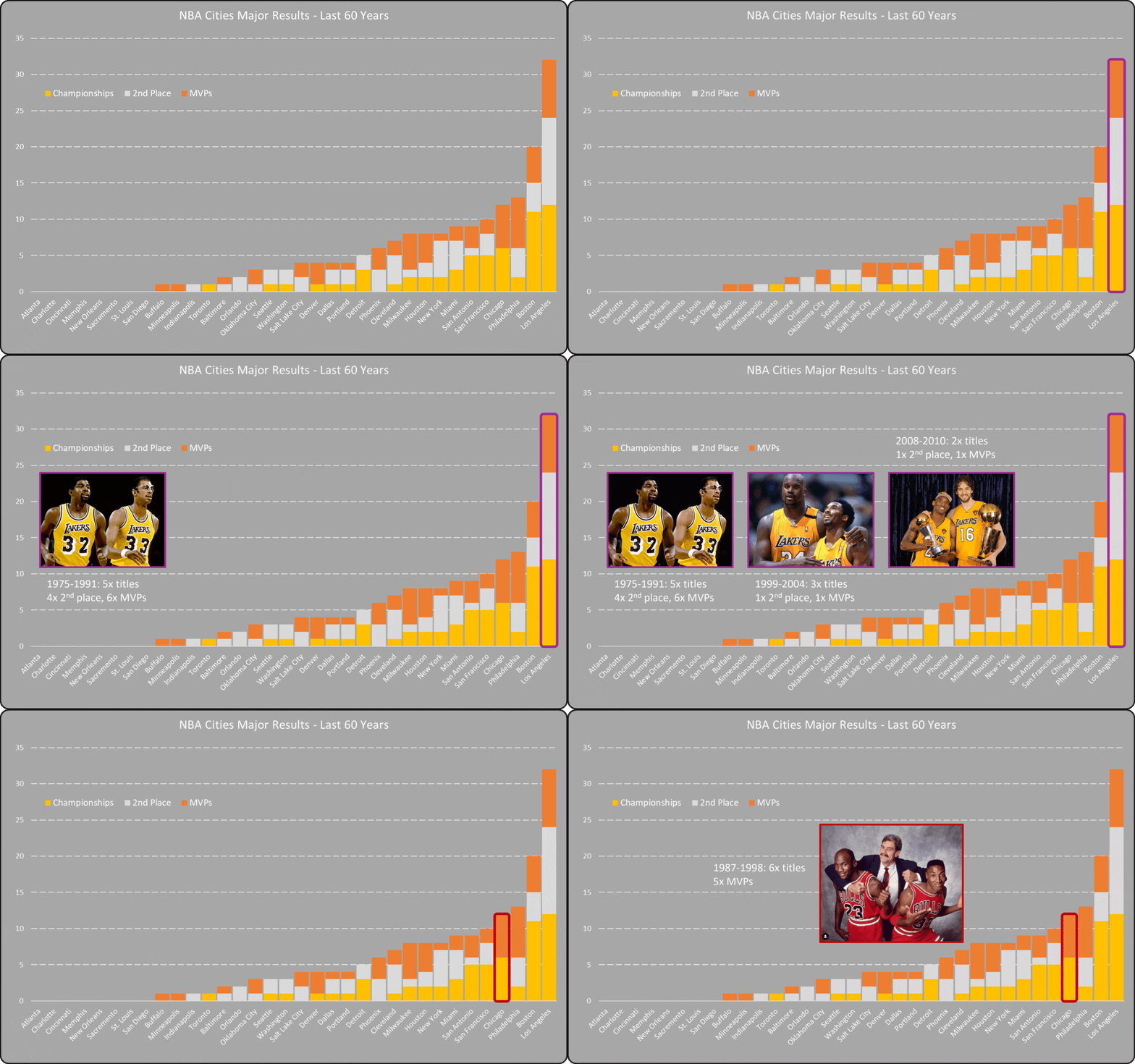
The Lakers - Celtics rivalry is a bit more lopsided when we make it just the last 60 years, with LA having the most titles, 2nd place, and MVPs in that span. I can say Lakers - Celtics when referring to LA, as the other LA based team, the Clippers, have never won a title or MVP. The other standout from this list is Chicago, as they come in 4th for total thanks almost solely to the Michael Jordan era. Which is crazy by the way! Take away Jordan and Chicago goes from 4th on this graph to only having a single MVP in the last 60 years. This list also has a lot more empty handed teams, with 8 teams not registering an appearance in the finals or an MVP award! It’s a pointy ended league…
Ok, baseball time. This one is a bit more data heavy as the MLB doesn’t do a total MVP award, instead giving one to each of the 2 conferences. As such we get a lot more MVP data points on our graph:
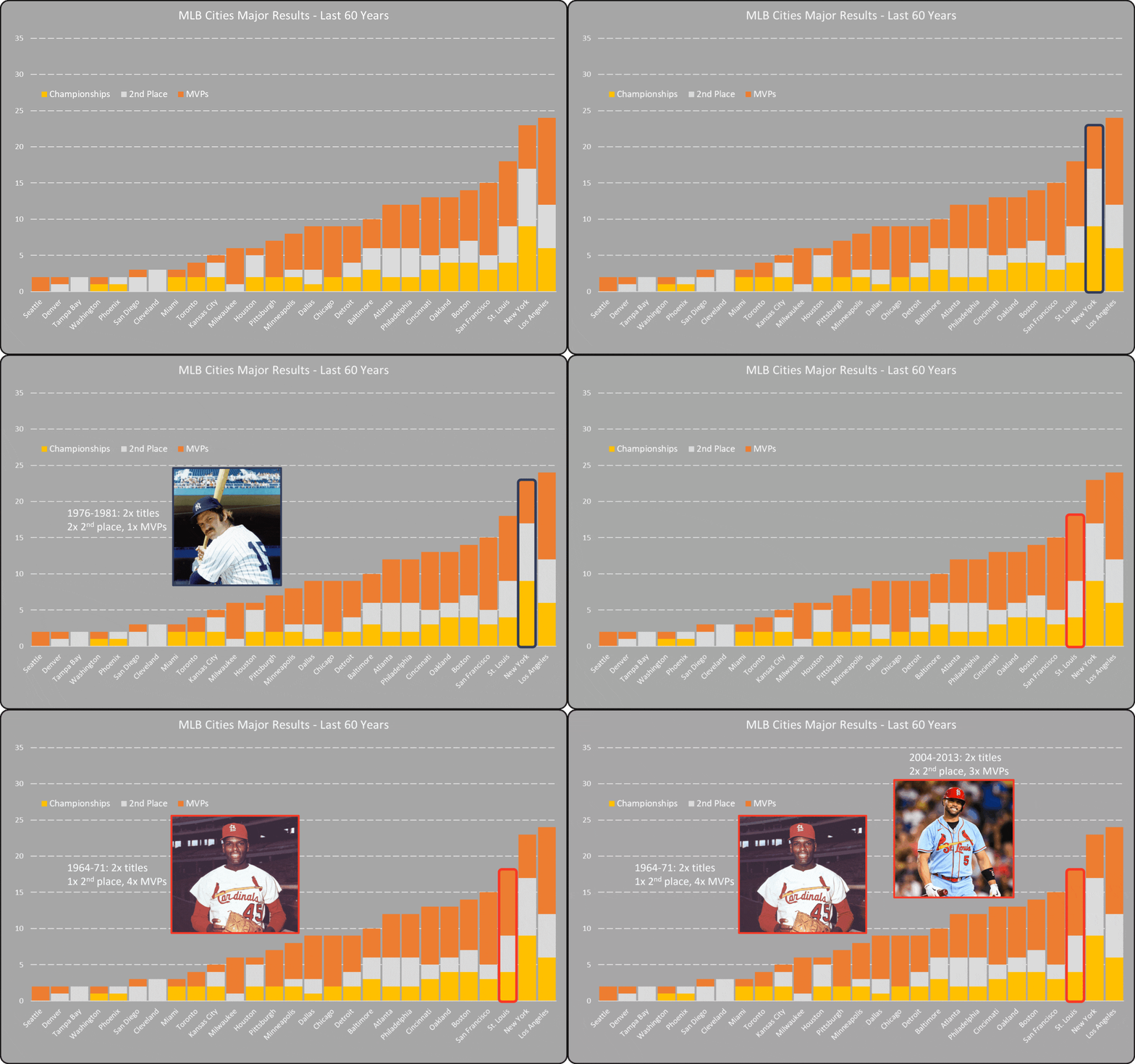
This is the league that best matches population, with the two biggest cities having the most titles and 2nd place results. St Louis is an interesting case though, with dynasties in the 1960s and 2000s giving them disproportionate success for their market size. The MLB is also the most represented league, with no teams left in the cold in terms of finals appearances or MVP awards.
Let’s check out the most international of the big leagues:
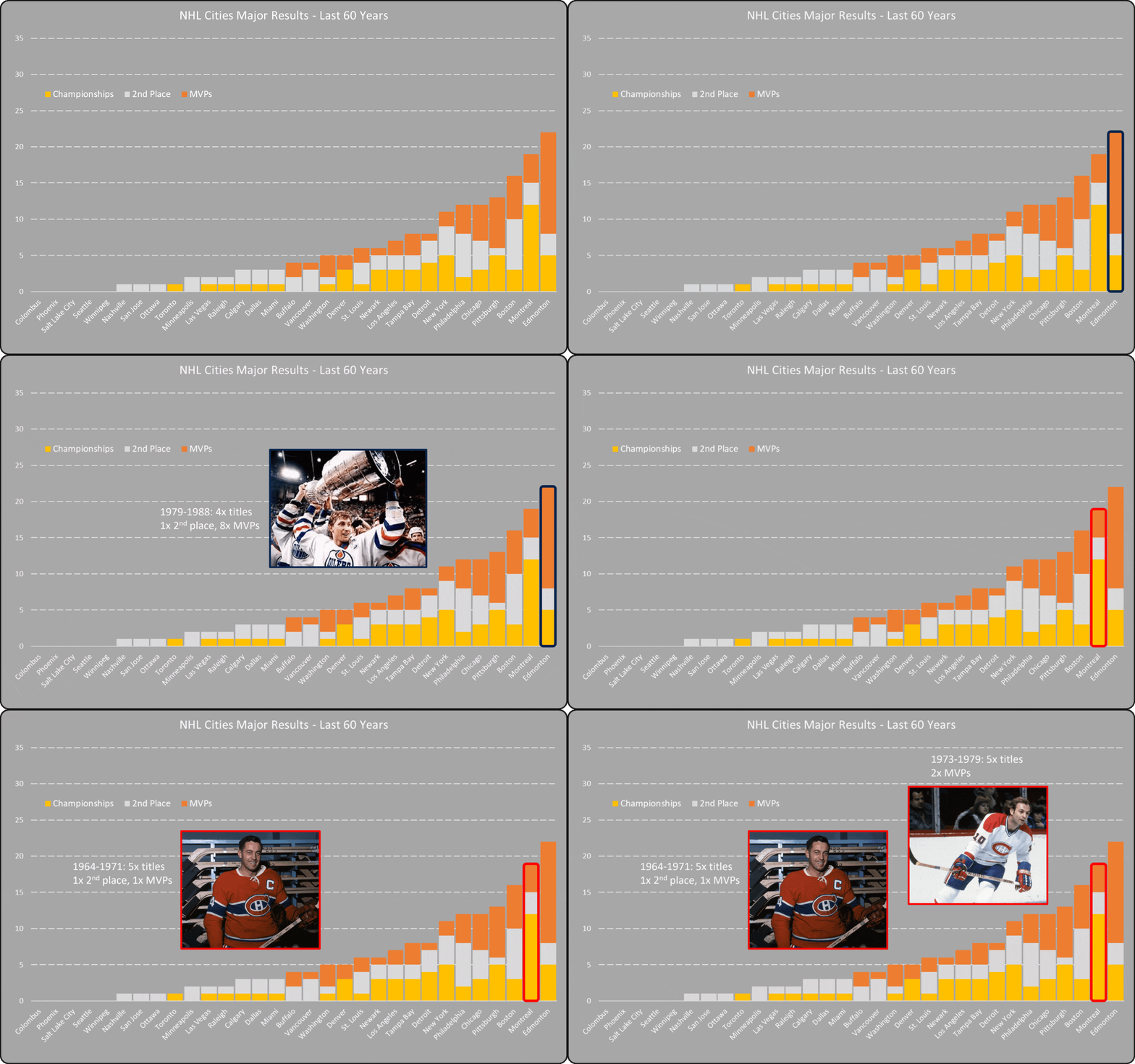
Edmonton leads the charge, but much like Chicago would be wayyyyyy down the pecking order if not for one incredible person, with 14 of their 22 entries on this list coming from Wayne Gretzky (the GOAT) alone. Montreal has by far the most titles though, with a whopping 12 in the past 60 years, more than double the next best, courtesy of absolute dominance in the 60s and 70s. The NHL is a lot pointier than baseball however, with 5 cities yet to register a finals appearance or MVP, and 11 cities never to win a championship. Interestingly, of those 11 finals free teams, only 3 are Canadian.
Now the smallest of our big 5 leagues, MLS. This leagues has only been running for around 30 years, so there’s a lot less data to go through and I haven’t included any images:
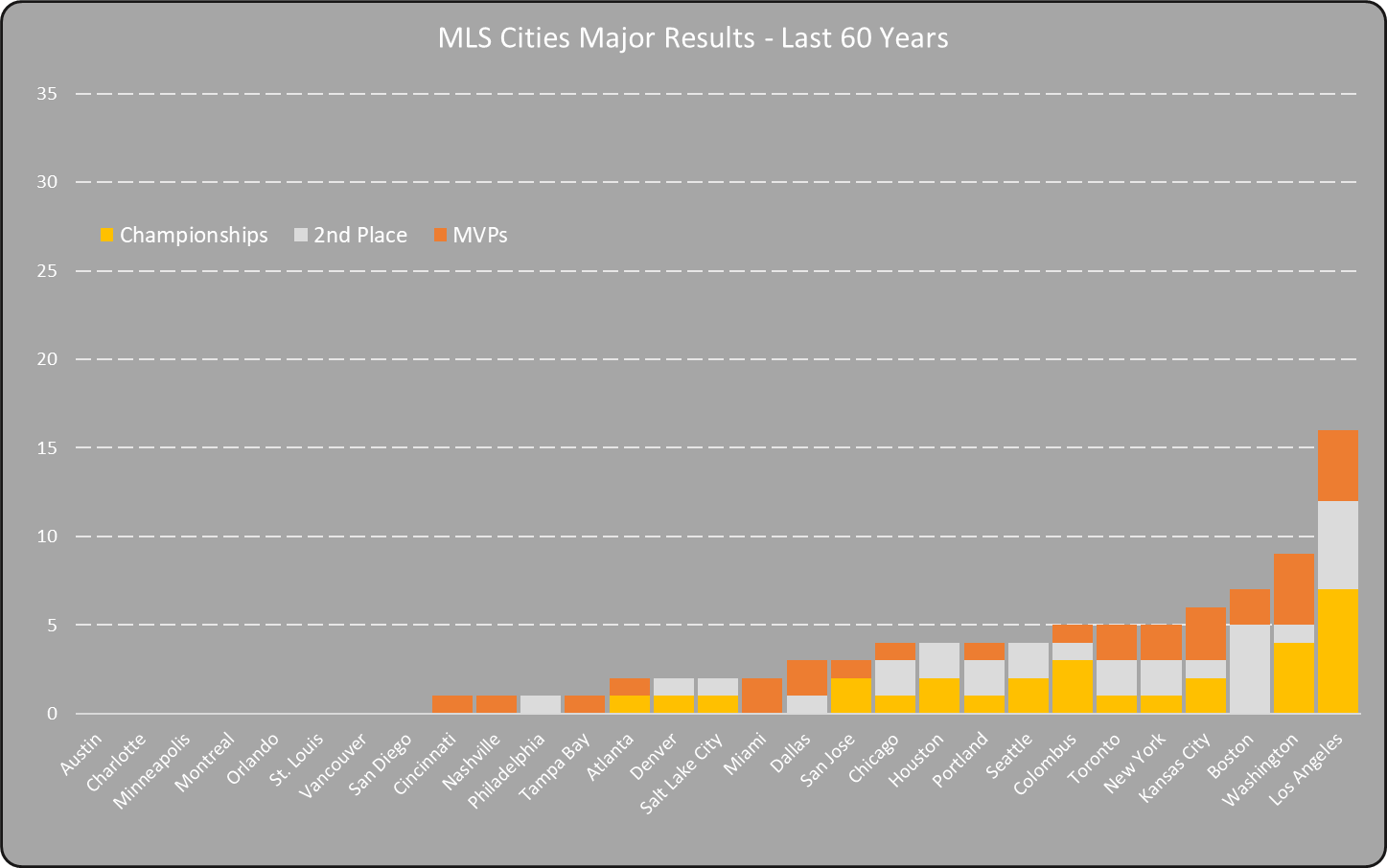
LA dominates the short history of the MLS, and 14 of the 30 teams (nearly half) have never won a title, and 8 of those teams haven’t tasted an MVP award or finals appearance either.
But, back to that chart of total results per city. What if we instead look at it by state? Well, here you go:
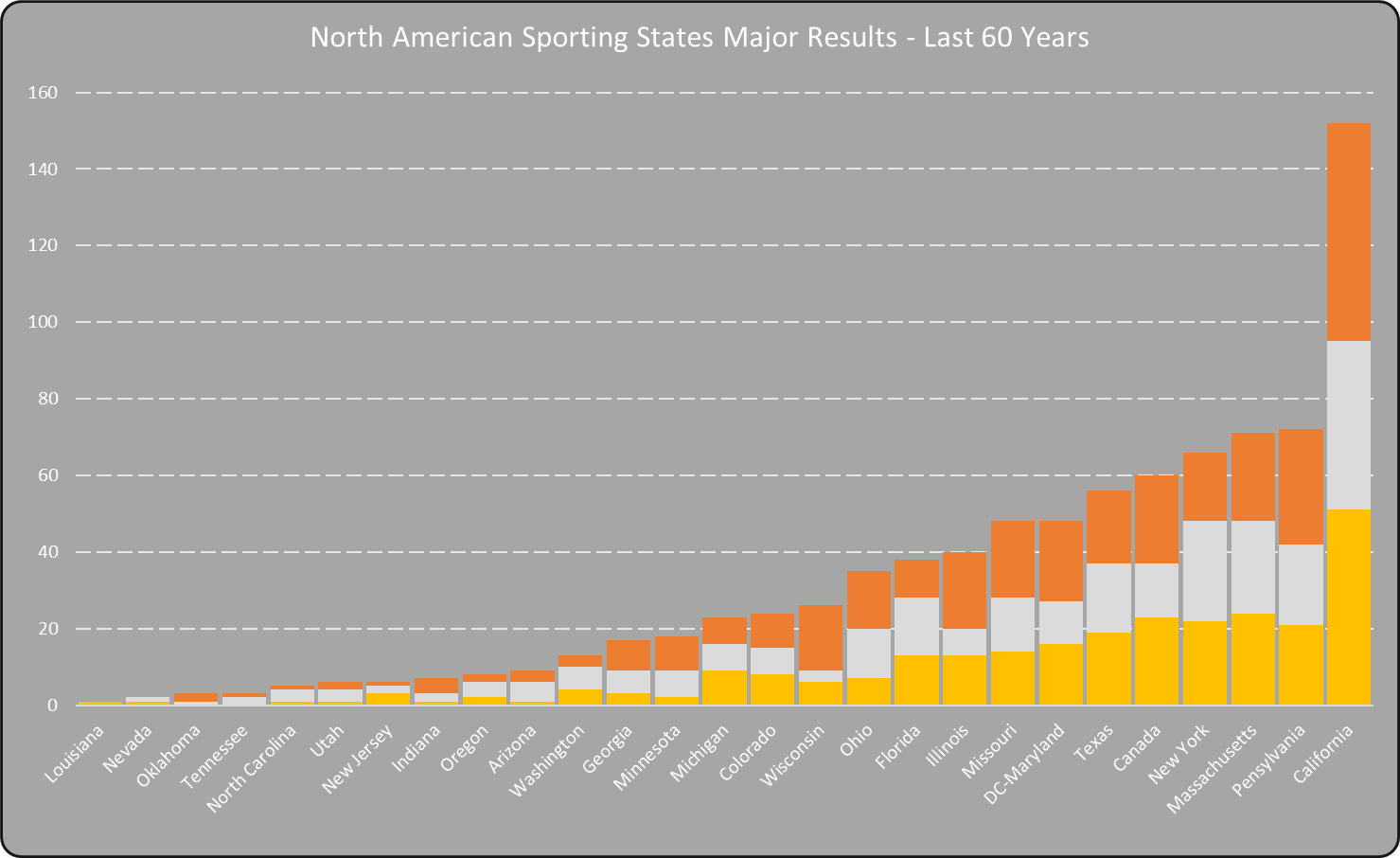
Sorry Canada for lumping all your teams together…
Of course you expect the big states to do well, with lots of teams and a large population to market to. And California is the wealthiest and most populated state in America, so of course it has a lot of teams and has had a lot of success. So let’s normalise our results by population and see how each state has fared on a per capita basis:
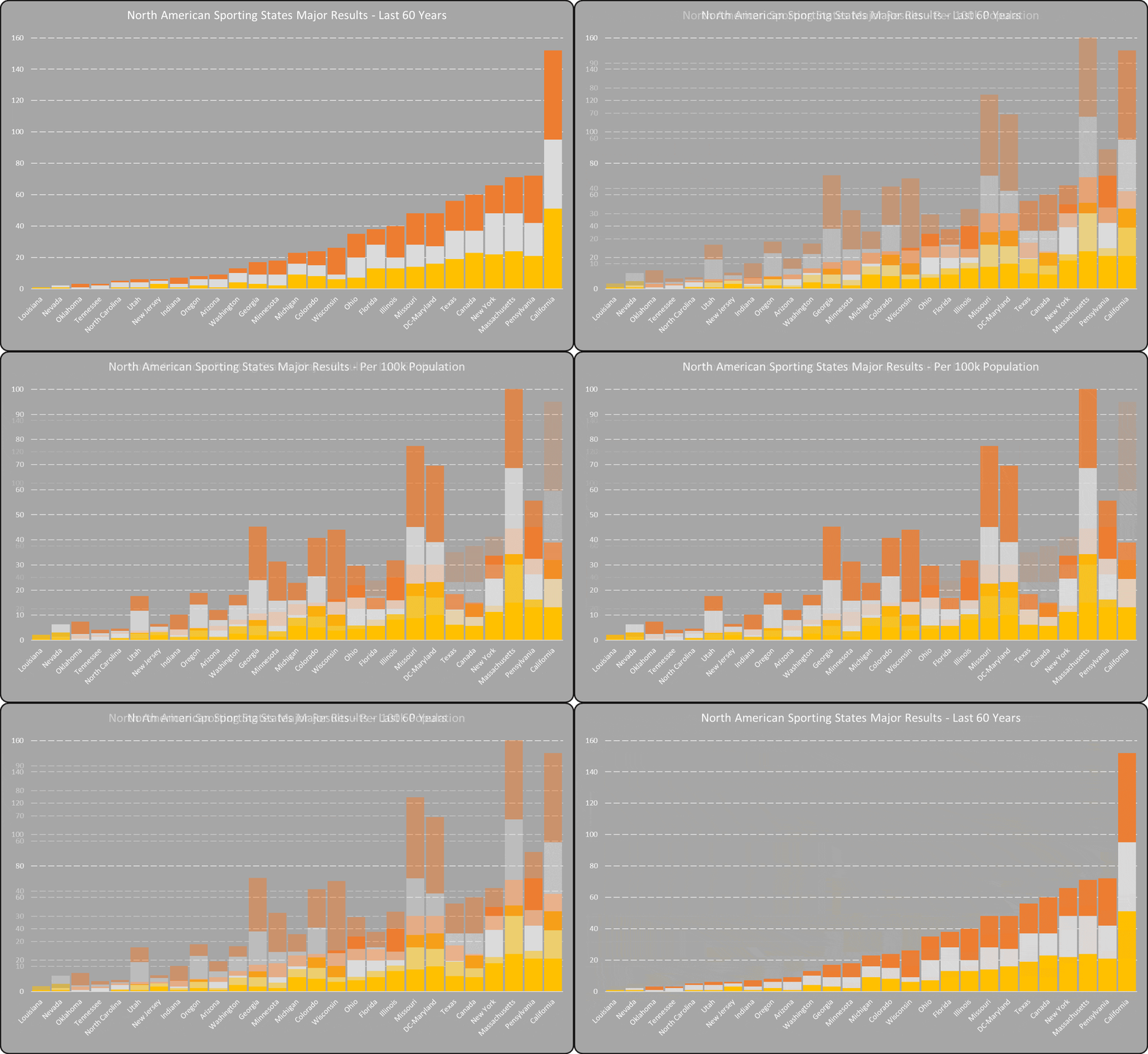
California comes back to earth, now in the middle of the pack, with similar per capita results as Colorado and Wisconsin. DC-Maryland and Missouri spike upwards, but it’s Massachusetts that really benefits from a per capita analysis. Quick note, I combined DC and Maryland because for a long time Washington DC has had lots of pro sports teams despite being a very small population. This is because it’s effectively surrounded by the built up metropolitan areas of Maryland, and so the teams more or less represent that broader region, so I combined them for this process.
But back to Massachusetts; what a result! I mean, they’re third of any state for totals, but when you consider their smaller population compared to the other sporting powerhouses, their results are amazing. Boston just seems to do well at sports, regardless of the code. They’re the only city in the top 5 of the above graphs for each sport, and for many of those they’re in the top 2. The Patriots, Celtics, Bruins, Red Sox, and the Revolution (of NFL, NBA, NHL, MLB, and MLS respectively) have all won MVPs and made multiple finals appearances.
If we look at city success across all 5 leagues, there are only 5 cities that have never had their team appear in the championship or have a player voted MVP (in the last 60 years) of any league:
Jacksonville, Florida
Memphis, Tennessee
Sacramento, California
Winnipeg, Canada
Austin, Texas
But each of those cities only have 1 team within the big 5 leagues. No city with multiple big league teams has failed to at least make a final or get an MVP. Then, no city with less than 5 teams makes the top echelons for success. Which makes sense. The best cities to live in over the past 60 years in terms of local sporting success are:
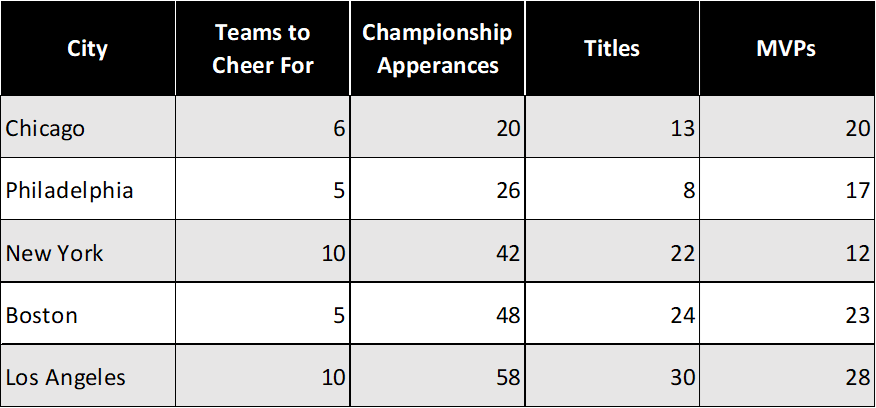
Yes, LA and NY have a lot of teams, so rivalries develop, and you wouldn’t find a Clippers fan cheering for a Lakers championship. But if you live in LA and the Lakers win, that’s a good vibe for the city, and with 10 sports teams that’s the best place to go for the most live sporting experiences. LA has also won the most titles and been in the most finals, averaging almost exactly 1 finals appearance per year over the past 60. Boston has the next most of each, despite having half as many teams competing, so from a per team perspective that’s the best place to live as your specific chosen team to follow has on average done very well. New York is down the list in terms of per team success, but has the same range of choice as LA (and a team across the way in New Jersey too), and almost as much total success as Boston. Phillie and Chicago have great per team numbers (better than NY, not as good as Boston), and have had the luxury of watching a local team compete in the finals of the big leagues roughly every 3 years or so.
But what about the least fortunate? For this I’m talking about cities that have lots of teams and still haven’t tasted success. Well, here are the cities with 4 or more big league teams that have had the least amount of finals and MVP players:
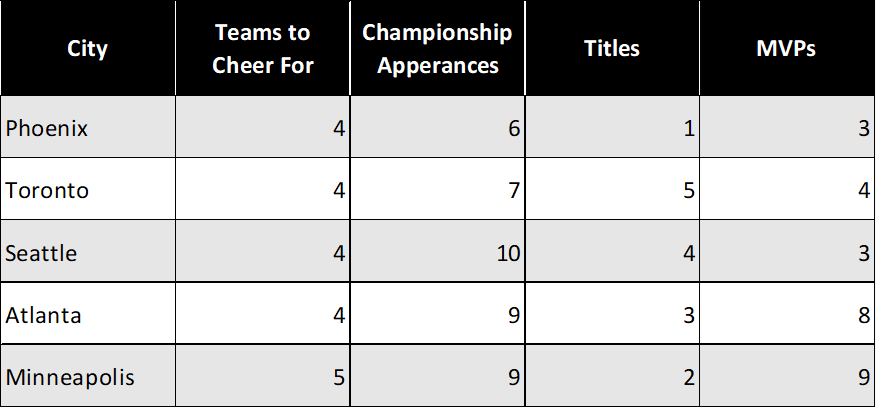
Minneapolis stands out as they have all 5 of the big leagues we’ve covered today playing there, and yet have only won 2 titles in the past 60. Atlanta has similar numbers (although with 1 less team), while Seattle and Toronto have at least won a few more titles, but on the flip side have boasted very few MVPs. But the least lucky of all is Phoenix, Arizona. 4 teams based there, but only 6 times ever in the finals with a single title to show for it, and only 3 MVPs across the 60 year span. In their defence, 3 of the 4 teams have only been playing in Arizona since the late 80s, so only 30-40 years instead of the full 60. Which if we’re being fair, we need to discuss that 2 teams each from Toronto and Minneapolis have only been around since the 90s, and as for Seattle, well the Seahawks were founded in the 70s, but the Kraken are only 5 years old, the football team only 30 years old, and their basketball team haven’t played since the 90s.
So if we take years of franchises present into consideration, it’s Atlanta that comes out the worst. The Hawks, Falcons, and Braves have all been in Atlanta since the 60s, and their MLS team since the formation of that league in the 90s. Which means from a per team, per year basis, Atlanta has had arguably the worst 60 years in pro sports in North America. Just ask Falcons fans about Superbowl 51. Actually, maybe don’t.
Having reached this point of the article, I realise that we haven’t explicitly mentioned any records, you know, the name of this series. So here’s a quick breakdown of today’s content in terms of actual records (all over the last 60 years):
Most titles across the big 5 leagues (city): Los Angeles, 30
[2nd place is Boston with 24]Most titles across the big 5 leagues (state): California, 51
[2nd place is Massachusetts with 24]Most championship appearances (city): Los Angeles, 58
[2nd place is Boston with 48]Most championship appearances (state): California, 95
[2nd place is New York and Boston, with 48 each]Most MVPs (city): Los Angeles, 28
[2nd place is Boston with 23]Most MVPs (state): California, 57
[2nd place is Pensylvania with 30]Most championships/2nd place/MVPs per person (state): Massachusetts, 101 per 100k people
[2nd place is Missouri with 77 per 100k people]Least combined (state): Louisiana, 1
[2nd place is Nevada with 2]
Least combined (city with at least 3 teams): Phoenix, 9
[2nd place is Toronto with 11]Least conbined (city with at least 3 teams for at least 30 years each): Atlanta, 17
[2nd place is Detroit with 23]Least combined per person (state): Louisiana, 2.2 per 100k people
[2nd place is Tennessee with 4.2 per 100k people]
And now we can discuss how breakable (or not) these records are.
As we can see, Boston is right on the heels of LA for all the individual city ones, and again, considering that Boston has 5 teams in the 5 leagues as opposed to LA’s 10, that’s an amazing feat. The small population of Massachussetts (where Boston is) compared to California does mean they take the per person record by storm. But, the totals per state record is well and truly in California’s hands. They have so many teams, and have had so many great dynasties in both LA and San Fran. So while LA itself could maybe some records to Boston over the coming decades (assuming Boston somehow continues it’s bizzarely good record in all sports), no state will ever catch California in terms of championships or most valuable players. Atlanta and Phoenix just need a few good years to shed their unwanted records, and likewise Louisiana, with it’s small population, just needs 1 or 2 more championship appearances/MVPs to jump up the per person results. And on that, there are a few states with small populations but lots of teams, like Minnesota, Winsconsin, and the greater DC-Maryland area, which could all challenge for best per person results if they could have a dynasty of success.
But as they Chiefs have just experience in the NFL, building dynsaties has never been harder in the big leagues than it is now. No team has ever 3-peated in the NFL, and no team has done it in any of the other leagues since the early 2000s. Even back-to-back championships have reduced significantly as factors like greater player agency, salary caps, draft order mechanics, and mass media’s more equitable distribution of resources means staying the best team is increasingly difficuly. Given these aspects, the fact that places like Boston and LA made their hay while they could, means their standing in the all time list of sporting megacities is as unchallengeable as the achivements of the players that got them there.
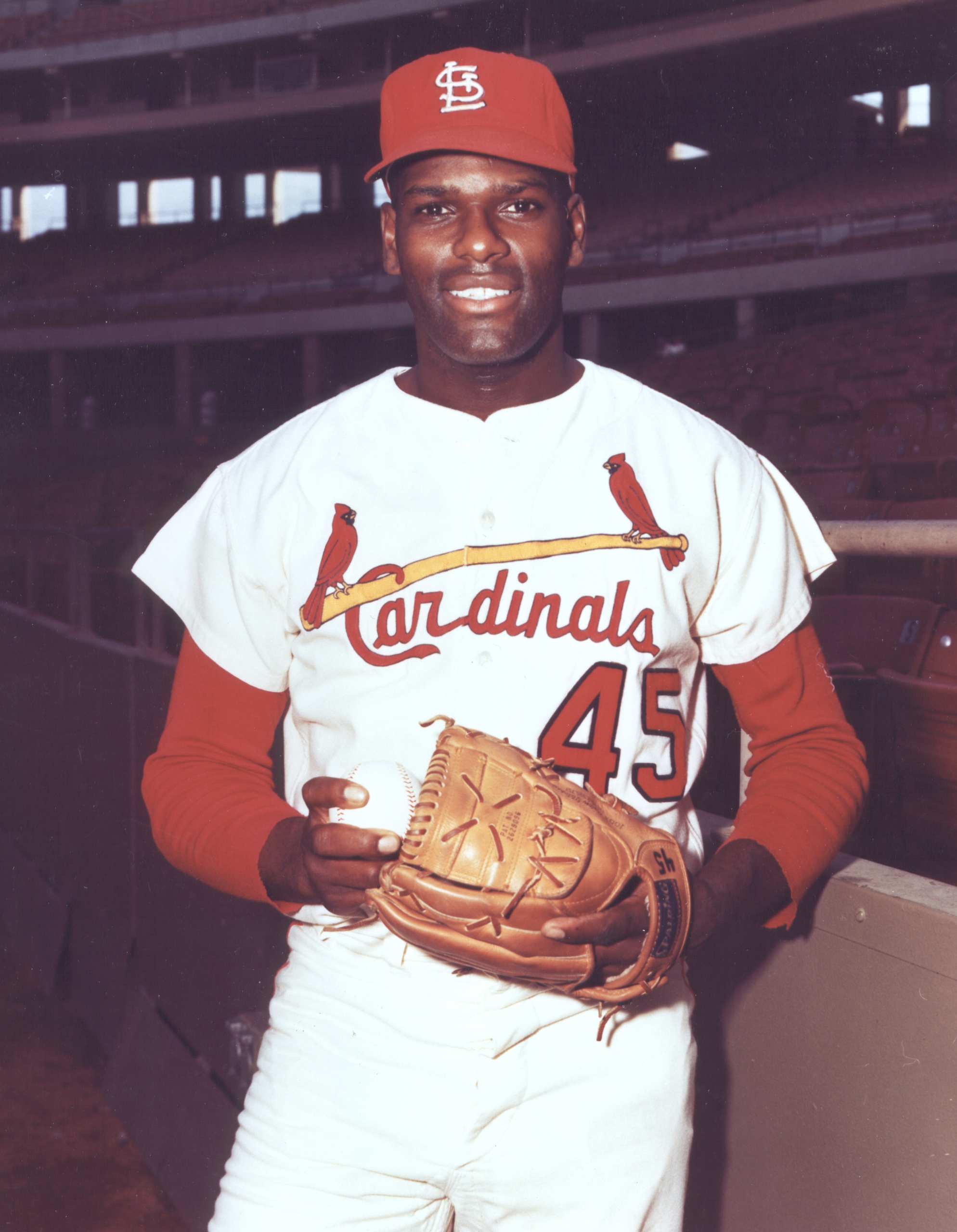
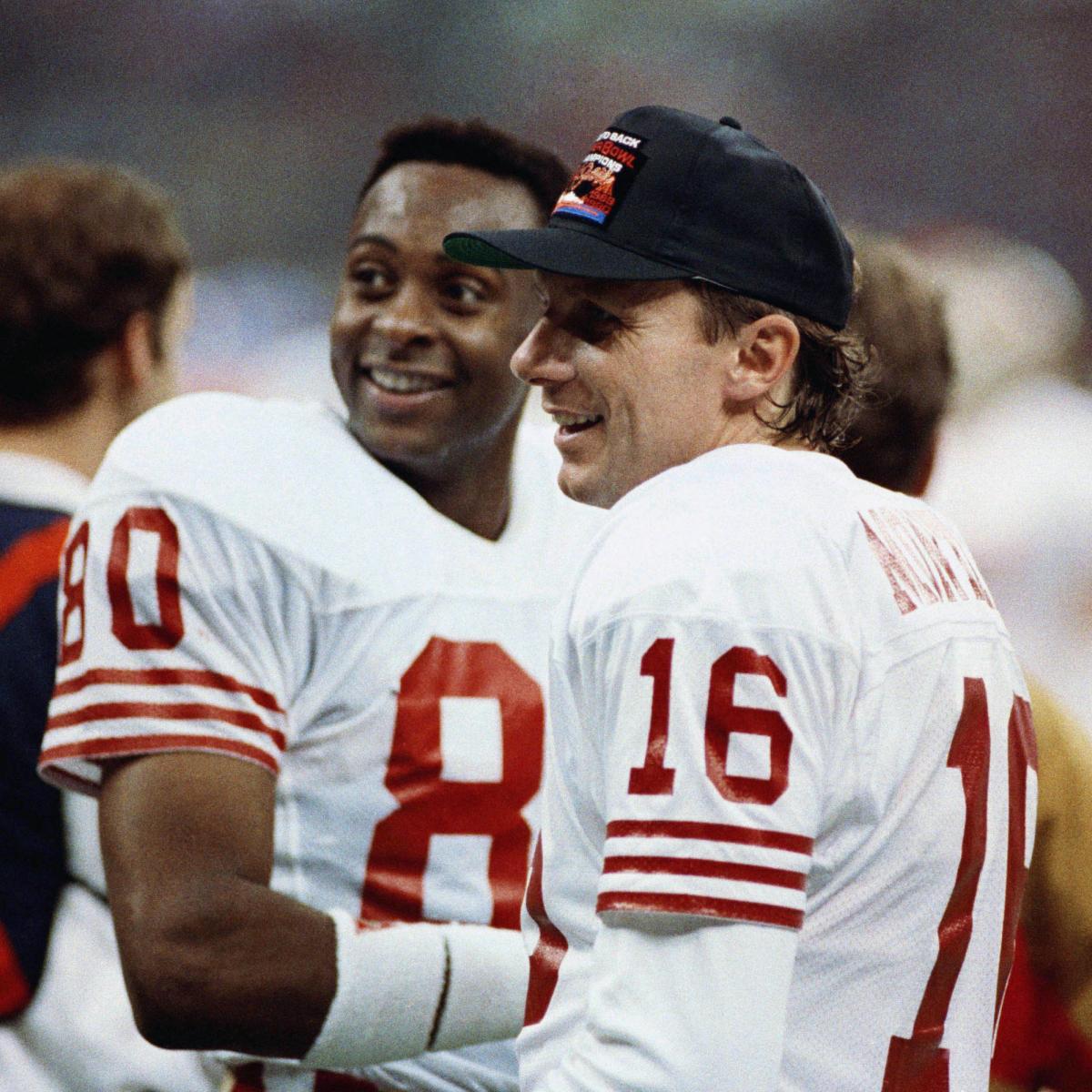
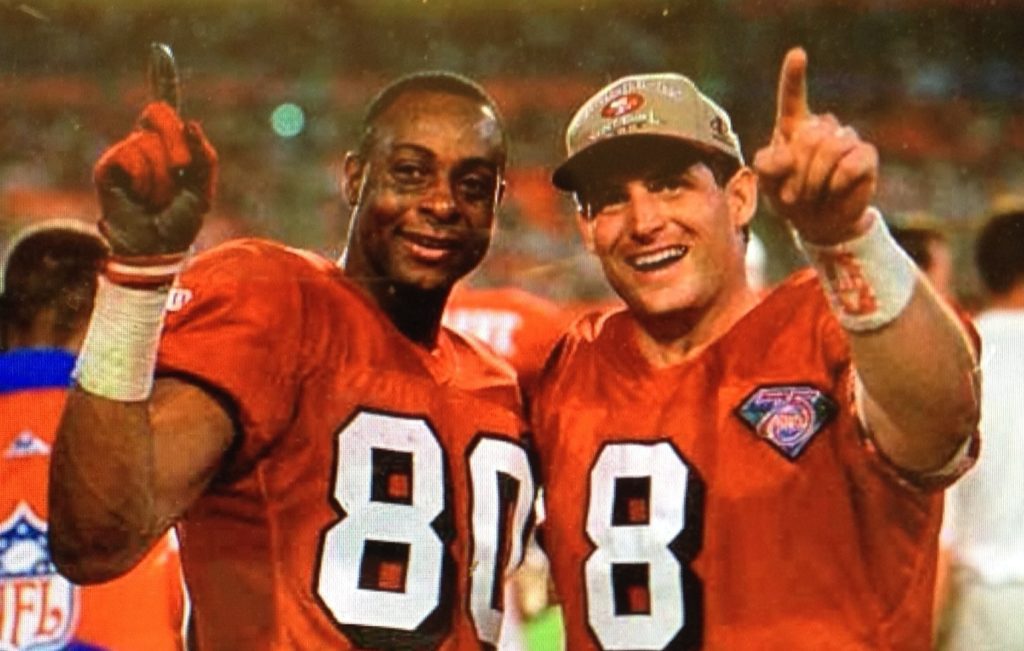
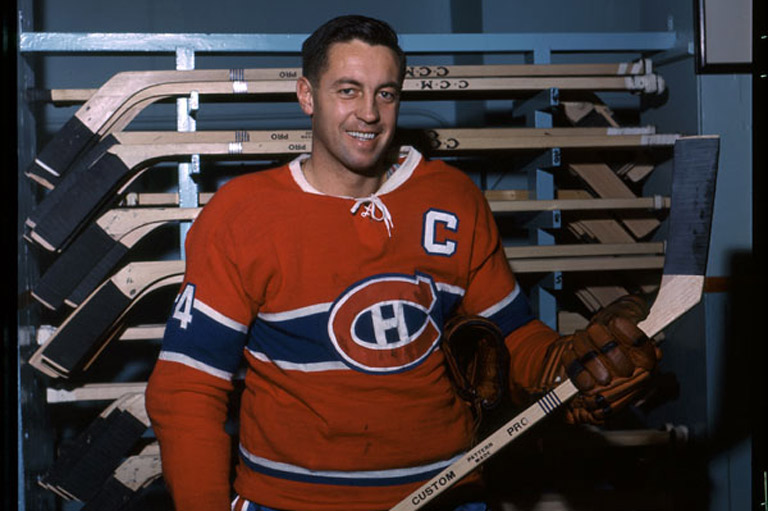
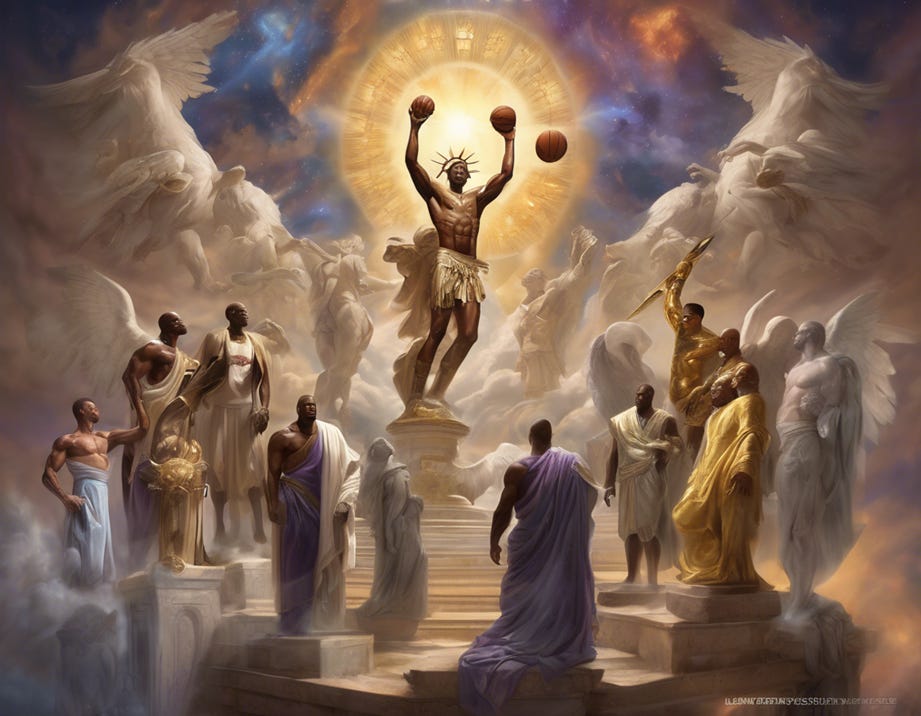
Here is some bad AI art of LA and Boston all time greats:

Thanks for reading
Images taken from:
Logos from their respective league websites
:max_bytes(150000):strip_icc():focal(749x0:751x2)/pau-gasol-kobe-bryant-3-9545b433a06a434f9a7fa61bd6c9c56c.jpg)

:max_bytes(150000):strip_icc():focal(783x0:785x2)/alex-rodriguez-1-0b410fea67ae4d8abcf3b9f5eb3301b1.jpg)